Ernie Pyle at Indiana University: College helped prepare storyteller for career as war correspondent

Bloomington will be the site of a special National Ernie Pyle Day celebration on Aug. 3. A number of speakers will focus on Pyle’s service reporting the lives of U.S. troops during World War II. What should also be remembered is
how his seven semesters at Indiana University and living in Bloomington, 1919-23, formed him and his later attention to war reporting. When Pyle was a high school junior, the U.S. entered World War I. Pyle, like so many other Americans at the time, was swept up in the fervor. His parents told Ernest (as they always called him) that first
he had to finish high school.

So when he finished high school in the late spring of 1918, he enlisted in the Navy Reserves. I don’t know why because he had little experience with water. He went to Champaign-Urbana for his basic training, something hard to imagine because there’s not much water there. He was due to be sent to the Great Lakes Naval Training Center in Chicago when the war ended.

He arrived in Bloomington in September, a hick from the sticks, speaking the dialect of southern Indiana. Student leadership at the time came from privileged families. They made fun of people such as Ernie Pyle.

But Ernie was smarter than they knew and he probably knew. In his firs year, he was turned down for admission to
a fraternity. One can imagine the fraternity brothers laughing at him. Pyle initially looked up to all of the war veterans who came flooding back to the IU campus. Then he listened to their stories and learned that war is hell. Men’s lungs had been scarred for life. His heroes had seen their fellow soldiers killed.

In 1922 he was chosen as a member of the steering committee for the Memorial Drive, to raise funds to build the Indiana Memorial Union, Memorial Stadium and Memorial Hall. He pledged $200, equal to an average month’s salary at the time.

He found a mentor in C E. Edmundson, the Dean of Men. In the spring of 1922, he joined the IU baseball team on a trip to Japan. Edmundson loaned him money to help him make the trip. (Today that would be considered improper). Imagine that Pyle was making an overseas trip that most Americans would not have dreamed of until recently. Because of his contract with the ship on which he worked, he couldn’t stop in Japan, but went on to China and the
Philippines.

When he returned from the Far East, he became summer editor of the Indiana Daily Student, as well as editor of the first Indiana State Fair issues of the Student. He advocated what he saw as the combined interests of the university and student.

In the fall of his senior year, he was chosen to be manager of IU football, selected by distinguished IU faculty, students and administrators. He was chosen to be a member of the Board of Aeons, an advisory board to the IU President.

He also was enrolled in a capstone course, which featured lectures by IU’s leading professors and administrators. A sketch of him in the 1923 Arbutus yearbook shows him as a campus leader.

Then he apparently had a run-in with one of his journalism teachers, and decided to leave IU and take a reporting job in La Porte, Indiana.

All of this prepared Pyle for his career. He had learned storytelling, but he had also emerged as someone who could associate with intellectual leaders. His career would never have reached World War II, without which we would not celebrate in August.


— Owen Johnson,
associate professor emeritus of journalism at Indiana University and the author of “At Home With Ernie Pyle”

Above: Cartoon sketch by Robert McKee of Ernie Pyle from the 1923 Arbutus yearbook. The text
refers to leadership roles Pyle held on campus including being a member of the Board of
Aeons and editor-in-chief of the Indiana Daily Student newspaper. Arbutus file photo.

Inspired by Ernie Pyle:The story of Ernie Pike & his creators

By Owen V. Johnson

Ernie Pyle’s influence appears in the most unexpected places.

In 1957 Héctor Germán Oesterheld (1919-1977?), an Argentine writer, and Hugo Pratt, an Italian comics artist, created a fictional war correspondent named Ernie Pike as a World War II character in their historietas (comics). The stories were first published in Hora Cera, an Argentine magazine, part of the publishing house Editorial Frontera that Oesterheld established. Pike became part of the Argentine popular imagination. Oesterheld was responsible for much of the success of Frontera by his excellent writing and the interesting adventure stories he spun.

Oesterheld assembled a topflight team of artists including the Italian Pratt, who illustrated the first Ernie Pike stories. Pratt, related to the actor Boris Karloff, was the son of an Italian soldier who was captured in North Africa and died in 1942 as a prisoner of war. His son and wife were also interned in a prison camp for a time. After the war young Pratt organized entertainment for Allied troops in Venice, where he had grown up. He was responsible for the first sketches of the person of Ernie Pike. His model was Oesterheld, although that was not what Oesterheld planned. Pratt returned to Europe in the early 1960s, where he published the Ernie Pike stories under his own name. He died in 1995. A succession of illustrators took over the Ernie Pike stories back in Argentina.

Pike makes handwritten entries in his notebook (something Pyle didn’t do), including both a general assessment of the situation, as well as personal impressions from the position of a civilian observer who knows war. As Pyle was in his writings, Pike is mostly an observer, but he differs from Pyle in that he is clearly a pacifist, something Oesterheld’s readers came to expect. He focuses on tragic events where things have gone wrong. Far more important for Oesterheld was the concept of the collective hero, in this case, the soldiers about which Pike was writing.

Initially Oesterheld placed Pike in World War II. Those stories place Pike in North Africa, the European Theatre and the Pacific, all places that Pyle wrote about, but Pike also can be found in the steppes of Russia. There are no descriptions of battles, only personal stories. As international communication specialist John Lent wrote, “All of [the characters] shared real, believable feelings and emotions, and a deep dislike for the situation they were stuck in.” Oesterheld, at the time a humanist, did not make judgments about the countries that were fighting, but only about personal morality. There is no clear good and evil. Germans were the good guys just as often as American G.I.s. In this regard, we should remember that even Ernie Pyle empathized with ordinary German soldiers captured in the final stages of the North African fighting in 1943.

Oesterheld, influenced by Stephen Crane, Erich Maria Remarque and Leo Tolstoy, among others, grew increasingly anti-war. He had Pike tell stories about the Korean War and the Vietnam War. Pike was an active character in these new stories and critical of US participation in Vietnam. Oesterheld was slowly becoming a political radical. He eventually affiliated with Montoneros, a left-wing terrorist group. He even wrote a strip about the Cuban guerilla fighter Ché Guevara.

Oesterheld was captured, imprisoned and tortured by the Argentine government in 1977 and apparently killed no later than early 1978. His family believed he was among the estimated 30,000 people to have disappeared and been killed by the government of the generals. In 1977 Oesterheld’s three daughters and their husbands also disappeared. One grandson, Martín, was born in captivity. Oesterheld’s widow, Elsa Sánchez, learned about the boy and recovered and raised him. A second grandson was raised by his paternal grandparents.

Pike outlived Oesterheld. In the follow-up to the attempted Argentine effort to seize the Falkland Islands from Great Britain in 1982, Pike reappears in a story written by Ricardo Barreiro. On one occasion, Pike asks an Argentine journalist whatever happened to a friend name Héctor Oesterheld, saying that he hadn’t been able to find him in Buenos Aires. The journalist tells him what happened and warns him not to mention Oesterheld’s name in public.

Collections of the Ernie Pike comics have been published not only in Spanish but also in French, Dutch and Italian. None of the Ernie Pike stories have ever been published in English, probably because of Oesterheld’s more complicated approach to war, his later radicalism and Pyle’s reputation as part of the so-called Good War. What Oesterheld succeeded in capturing in Ernie Pike was Ernie Pyle’s description of the pain and tragedy of war and how it changes people, and his ambivalent attitude toward war in general. That’s one of the themes of his writing that has received less attention over the years but that his World War II readers would have recognized.

— Owen Johnson is a historian, associate professor emeritus at Indiana University and author of  “At Home with Ernie Pyle.”

Museum adds bust of Pyle to collection

By Ruth Witmer

The latest addition to the Ernie Pyle WWII Museum is a bust of the renowned correspondent created by journalist-turned-sculptor David Ross Stevens.

 Stevens graduated from the University of Iowa with a degree in journalism. 

“I became a journalist only eight years after Ernie died,” Stevens said.

Stevens started his career as a roving feature writer for the Telegraph-Herald in Dubuque, Iowa, and then became a wire editor. He spent two years as a managing editor in Henderson, Kentucky, before moving on to the Courier-Journal in Louisville. At the CJ, he was the paper’s first investigative environment writer.

Stevens said he always had a latent interest in art. He considered the act of building his own solar house a creative venture — almost like sculpture — and decided he wanted to do more things like that.

“I happened to be friends with a bunch of artists. In my 40s, that’s when the turning point came,” said Stevens who took his first drawing class at age 46.

“I hadn’t touched a piece of clay before age 50,” said Stevens who makes his home in southern Indiana with his wife, Rose.

Stevens said most of his pieces are commissions but he did Pyle on his own initiative and then decided to donate it.

“That was just a fun thing for myself since I had been in journalism,”  he said. 

The artist has a variety of sculptures and busts displayed in public places. In Indiana, his work includes renderings of abolitionist Frederick Douglass at Division Street School in New Albany; Supreme Court Justice Sherman Minton in the Floyd County Public Library; Lucy Higgs Nichols, an escaped slave who served as a nurse for the Union Army during the Civil War, at the Carnegie History and Art Museum in New Albany; and a full-body bronze of golfer Fuzzy Zoeller at his course in Sellersburg.

Stevens said he has become a big fan of Pyle’s writing and can relate him to people he knew growing up.

“A half dozen guys within site of our house were in WWII and they were all the kinds of guys Ernie was writing about — the sergeants and corporals and privates.”

Stevens said the bust he’s donating to the museum is about 10 inches high and was done using cast stone.

The method was new to Stevens when he created the piece. It involves mixing a powdered marble material with a catalyst and water.

“I had made him in clay then made a rubber mold around the clay. I took that rubber mold and pressed this new cast stone into it and out came Ernie Pyle — and I was so pleased.”

Museum hosts author panel on war correspondents Saturday, Nov. 6 at Helt Township Fire Department

Authors Owen Johnson and Ray Boomhower will be featured in a discussion of war correspondents on Saturday, Nov. 6 in Dana, Indiana. Friends of Ernie Pyle President Steve Key will moderate the panel that is open to the public.

The Ernie Pyle World War II Museum will host an author’s panel to discuss the lives and work of several war correspondents on Saturday, Nov. 6. Ray Boomhower, who recently released his latest book, “Richard Tregaskis: Reporting under Fire from Guadalcanal to Vietnam,” and Owen Johnson, author of “At Home with Ernie Pyle,” will talk about those and other WWII correspondents and take questions from the audience. Friends of Ernie Pyle Board president Steve Key will serve as moderator.

The event will be held at the Helt Township Fire Department building in Dana. It will start at 11 a.m. and finish at 12:30 p.m. Boomhower and Johnson have agreed to sign books after the event that people decide to purchase. The author’s selections will make fine gifts for one’s history-loving family or friends.

The author’s panel will be held following the Annual Meeting of the Friends of Ernie Pyle, which begins at 9:30 a.m. on that Saturday.

The museum will be open that weekend, so anyone attending the panel can easily tour the museum and birthplace of Ernie Pyle following the event. Admission is free through a contract between The Friends of Ernie Pyle and Helt Township Trustee.

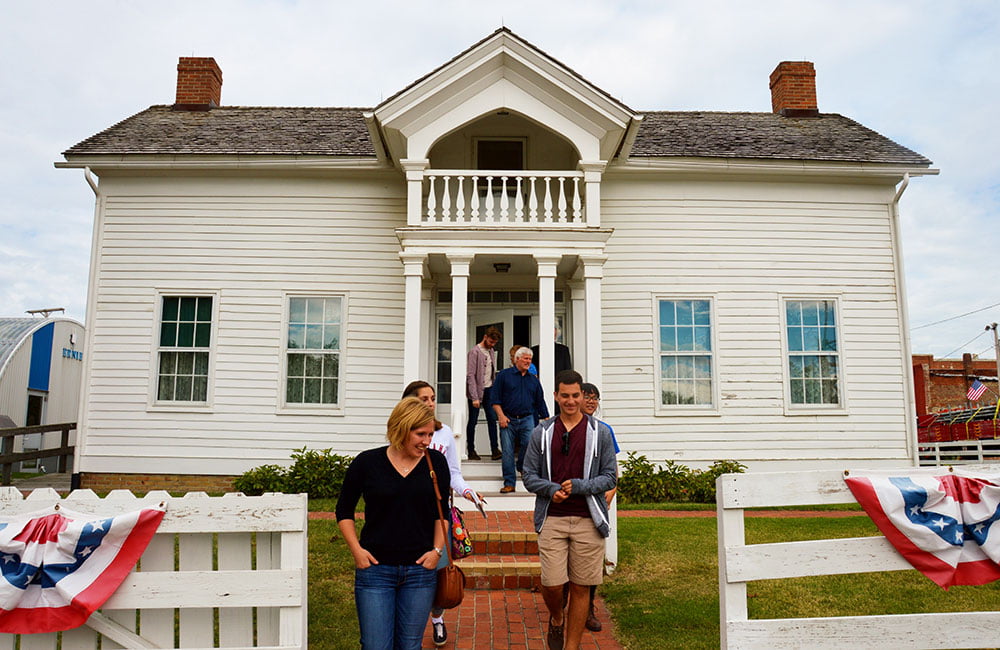
The Friends of Ernie Pyle, a non-profit charitable organization have operated the Dana museum since 2011 – taking over the management after the Indiana Department of Natural Resources made the decision to decommission the historic site. The museum includes the 1851 farmhouse where Ernie was born on Aug. 3, 1900, and two Quonset huts that contain exhibits and theatres that feature the stories written during World War II by Pyle, who won a Pulitzer Prize for his work in 1944.

Elder-Pyle House placed on the National Register

The Indiana Department of Natural Resources informed the Friends of Ernie Pyle that the birthplace of the World War II correspondent has been placed on the National Register of Historic Places.

 The federal Department of the Interior added the Elder-Pyle House on the National Register on Aug. 25. DNR told The Friends of Ernie Pyle that the official State and National Register certificates will be presented during a special ceremony at the Indiana State Fair in August of 2022 in Indianapolis.

“We are ecstatic over this level of recognition for the historical and cultural significance bestowed on Ernie Pyle’s birthplace,’ said Steve Key, president of the Friends of Ernie Pyle. “We hope this national designation will allow us to tap into resources that will help us preserve the legacy of our nation’s best-known war correspondent.

“It’s important that Hoosiers and Americans understand the hardships and accomplishments of the generation that survived the Great Depression and then were asked to fight a war to preserve our democratic freedoms,” Key said.

Authorized by the National Historic Preservation Act of 1966, the National Register of Historic Places is the official inventory of sites with national, state, or local significance in the development of our nation’s cultural heritage. Listing on the National Register is official recognition of the significance of the farmhouse and provides a measure of protection for the property.

In Indiana, the National Register is administered by the Department of Natural Resources. In addition to a degree of environmental protection, owners of listed properties may be eligible to apply for matching federal grants for restoration or preservation work if funds are available.

The Friends of Ernie Pyle hope the new recognition will bring extra points to its current effort to receive funding from the state’s Historic Renovation Grant Program to restore the clapboard siding of the farmhouse built in 1851 by the Elder family. Pyle was born in the white, two-story farmhouse with Greek Revival features on Aug. 3, 1900.

The Friends of Ernie Pyle have been saving contributions for years to afford the much-needed repair work. They were greatly helped with a $39,000-plus donation from the Indiana Department of the American Legion, when then-State Commander Rodney Strong made the museum his personal project in office.

“I think it is great,” Strong said of the National Register designation. It has been a long time coming.”

JOIN ERNIE'S EMAIL LIST