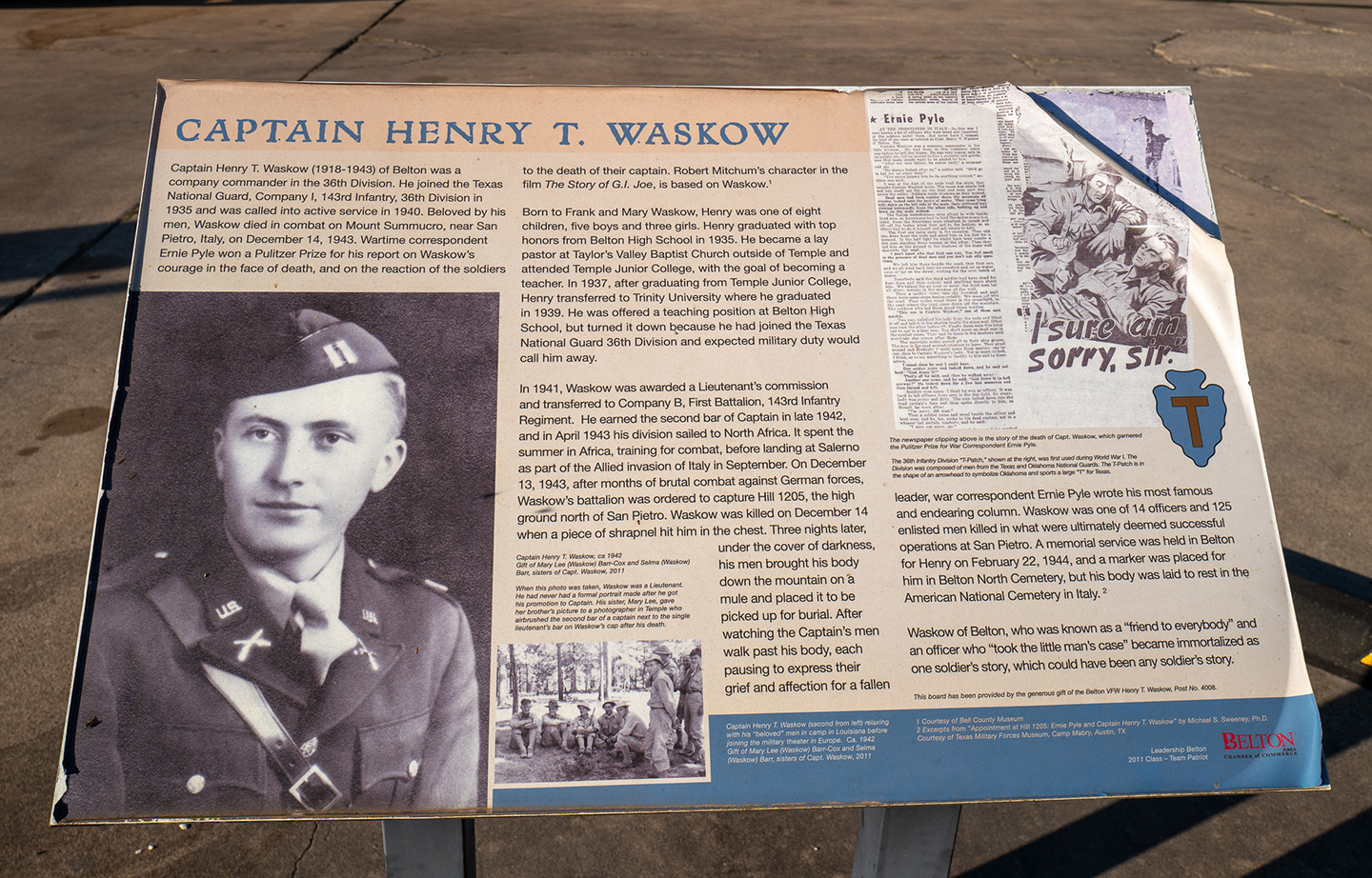
Bloomington will be the site of a special National Ernie Pyle Day celebration on Aug. 3. A number of speakers will focus on Pyle’s service reporting the lives of U.S. troops during World War II. What should also be remembered is
how his seven semesters at Indiana University and living in Bloomington, 1919-23, formed him and his later attention to war reporting. When Pyle was a high school junior, the U.S. entered World War I. Pyle, like so many other Americans at the time, was swept up in the fervor. His parents told Ernest (as they always called him) that first
he had to finish high school.
So when he finished high school in the late spring of 1918, he enlisted in the Navy Reserves. I don’t know why because he had little experience with water. He went to Champaign-Urbana for his basic training, something hard to imagine because there’s not much water there. He was due to be sent to the Great Lakes Naval Training Center in Chicago when the war ended.
He arrived in Bloomington in September, a hick from the sticks, speaking the dialect of southern Indiana. Student leadership at the time came from privileged families. They made fun of people such as Ernie Pyle.
But Ernie was smarter than they knew and he probably knew. In his firs year, he was turned down for admission to
a fraternity. One can imagine the fraternity brothers laughing at him. Pyle initially looked up to all of the war veterans who came flooding back to the IU campus. Then he listened to their stories and learned that war is hell. Men’s lungs had been scarred for life. His heroes had seen their fellow soldiers killed.
In 1922 he was chosen as a member of the steering committee for the Memorial Drive, to raise funds to build the Indiana Memorial Union, Memorial Stadium and Memorial Hall. He pledged $200, equal to an average month’s salary at the time.
He found a mentor in C E. Edmundson, the Dean of Men. In the spring of 1922, he joined the IU baseball team on a trip to Japan. Edmundson loaned him money to help him make the trip. (Today that would be considered improper). Imagine that Pyle was making an overseas trip that most Americans would not have dreamed of until recently. Because of his contract with the ship on which he worked, he couldn’t stop in Japan, but went on to China and the
Philippines.
When he returned from the Far East, he became summer editor of the Indiana Daily Student, as well as editor of the first Indiana State Fair issues of the Student. He advocated what he saw as the combined interests of the university and student.
In the fall of his senior year, he was chosen to be manager of IU football, selected by distinguished IU faculty, students and administrators. He was chosen to be a member of the Board of Aeons, an advisory board to the IU President.
He also was enrolled in a capstone course, which featured lectures by IU’s leading professors and administrators. A sketch of him in the 1923 Arbutus yearbook shows him as a campus leader.
Then he apparently had a run-in with one of his journalism teachers, and decided to leave IU and take a reporting job in La Porte, Indiana.
All of this prepared Pyle for his career. He had learned storytelling, but he had also emerged as someone who could associate with intellectual leaders. His career would never have reached World War II, without which we would not celebrate in August.
— Owen Johnson,
associate professor emeritus of journalism at Indiana University and the author of “At Home With Ernie Pyle”
Above: Cartoon sketch by Robert McKee of Ernie Pyle from the 1923 Arbutus yearbook. The text
refers to leadership roles Pyle held on campus including being a member of the Board of
Aeons and editor-in-chief of the Indiana Daily Student newspaper. Arbutus file photo.